















TECHNOLOGY
Electrolon’s advanced technology will improve effectiveness in many areas of pest management including mosquitoes, flies, termites, bedbugs, spiders, ants, etc.!
Benefits:
- Maximum coverage
- Improved initial knockdown
- Longer residual time
- Longer time between treatments
- Less chemical used due to better coverage and increased time between treatments
- Labor and cost savings due to reduced call backs and chemicals needed
Lab Report Highlights
“Electrolon technology clearly provided a far superior residual to the bottom surfaces of the panels, which is evident at the 15 day and 30 day periods.”
“Electrolon provided 360 degree coverage and essentially doubled the killing power of the residual applied to surfaces.”
Download Full Report - (1.6M PDF format) 
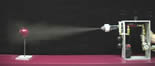
Introduction to Technology 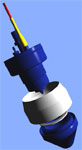 Electrolon sprayers produce electrically charged spray droplets which are carried in a high speed air-stream. The heart of the Electrolon sprayer is the patented “air-atomizing induction-charging” nozzle. Air and liquid enter separately at the rear of the nozzle. The air moves at a high speed through the nozzle and intersects the liquid at the nozzle tip, causing the formation of spray droplets.
After the liquid is atomized, the droplets pass an electrode which induces a charge on each droplet. Droplet size is 30 to 40 microns.
Since the droplets are charged they attract to surfaces instead of drifting away or falling to the ground. Electrical charging creates an attraction force between the spray droplets and target surfaces.
The charge on the spray droplets is small, but the force of attraction is strong since spray particles are relatively lightweight. The electrical force that pulls the spray towards the target is 40 times greater than the force of gravity. This means that droplets will reverse direction and move upwards to cover the underside of leaves, the backside of stems, and other hard to reach areas.
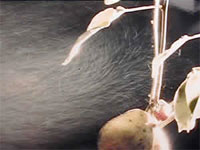
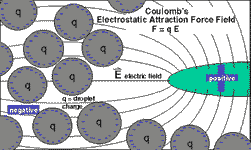
The result of using an Electrolon sprayer is more than twice the deposition efficiency of hydraulic sprayers and non-electrostatic types of air-assisted sprayers.
Where do you want your chemicals to go?
Tests at the University of Georgia demonstrate the effectiveness of Electrolon sprayers.
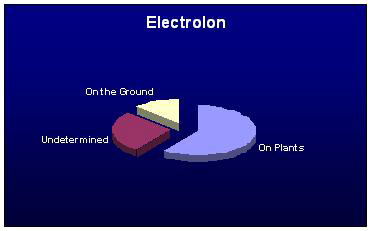
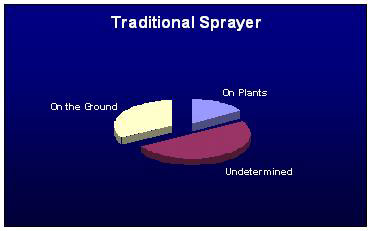
Analysis of Spray Deposition With Computer Vision System
These photographs show Electrolon’s effectiveness at reaching the underside of surfaces.
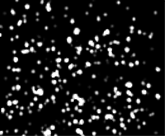
Electrolon sprayer: 425 drops per 10 square millimeters
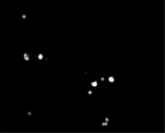
Hydraulic sprayer: 6.3 drops per 10 square millimeters
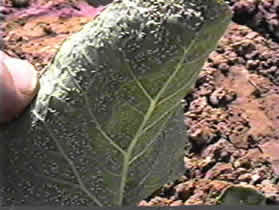
This photograph shows how insect populations live mostly on the leaf underside. In this case several treatments had been applied with a traditional sprayer with full chemical rates. As you can see the insects on the underside were not controlled.
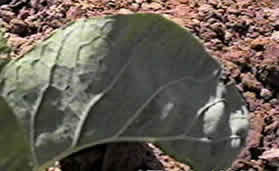
This is the same leaf after spraying with an Electrolon sprayer. This photograph was taken 4 hours after treatment with only 50% of chemical rate.
Selected Research Publications on Electrostatic Spraying, Pesticides, and Spray Efficiency
Electrolon has assembled a list of selected research publications on electrostatic spraying, pesticides, and spray efficiency.